Visualisation & Statistics
Welcome to the LUISA Data Visualization Portal
Gain deeper insights into Africa’s environment, land use, and sustainability through interactive data exploration and storytelling.
Dive into interactive maps, charts, and scenario-based models that highlight key topics such as:
- How people shape ecosystems through land use and harvests
- Farming, grazing, and forest productivity across Africa
- The balance between agricultural expansion and sustainability
- Challenges like deforestation, land degradation, and climate pressures
- Case studies across Africa – from Ethiopia’s Lake Tana Basin and Mozambique’s Beira Corridor to Senegal’s Ferlo Silvopastoral Zone and Uganda’s Mount Elgon highlands
Analyse Data on Africa’s Resources and Land Systems
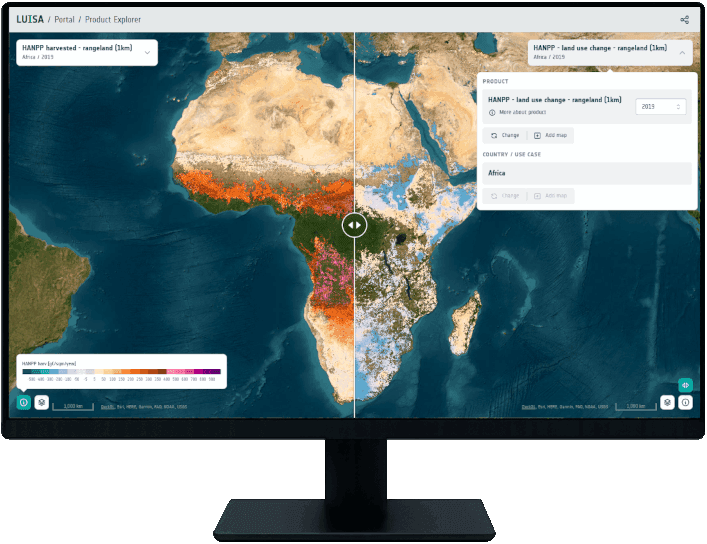
The LUISA platform offers a powerful, interactive interface to explore a wide range of sustainability-related indicators across space and time.
Visualizations are delivered through dynamic maps, charts, and dashboards that allow users to explore scenarios, compare regions, and interpret data in real time—all in one centralized and user-friendly environment.
Use Cases
Explore real-world applications of the LUISA platform through interactive story maps.
Statistics
Access aggregated information calculated from the LUISA platform’s data layers.
Explore the aggregated statistics derived for African countries based on the original datasets. Examine how key indicators—such as actual Net Primary Production (NPP actual), potential Net Primary Production (NPP potential), and Human Appropriation of Net Primary Production (HANPP harvested)—have evolved over time. The results are calculated across different types of land use, allowing you to better understand how agricultural areas, forests and rangeland contribute to overall dynamics. Visualize temporal changes, identify long-term trends, and observe how these indicators vary across national contexts. Compare countries side by side to gain deeper insights into regional patterns, land-use impacts, and the broader implications for sustainability and resource management.